What to See Inside the Ben Youssef Madrasa, Room by Room
A route through the building in the order you walk it, with the details most visitors walk past.
Book this visit
Some links are affiliate links: if you book, we may earn a commission at no extra cost to you. How this works
 Madrasa ticket paid on site
Offer 1
Ben Youssef Madrasa, Secret Garden and souk walking tour
A certified guide for the madrasa, Le Jardin Secret and the souks, in groups of up to 15. Entries are not included.
- 3–4 hrs
- Small group
- Free cancellation
Live guide: Arabic, English
From €14 per person · Nov 2026
Check dates — Ben Youssef Madrasa, Secret Garden and souk walking tour, Viator (opens in a new tab) Madrasa ticket paid on site
Offer 2
Ben Youssef Madrasa and Secret Garden guided tour
The madrasa and Le Jardin Secret, then Jemaa el-Fna and the Koutoubia, in groups of up to 15. Both entries are paid on site.
- 3 hrs
- Small group
- Free cancellation
Live guide: English, French
From €14.10 per person · Nov 2026
Check dates — Ben Youssef Madrasa and Secret Garden guided tour, Viator (opens in a new tab) Madrasa ticket paid on site
Offer 3
Ben Youssef Madrasa, Jardin Secret and souks guided tour
Small group or private: with the private option the guide picks you up at your riad in the medina. Entries are extra.
- 4 hrs
- Private
- Free cancellation
Live guide: English, French
From €25 per person · Nov 2026
Check dates — Ben Youssef Madrasa, Jardin Secret and souks guided tour, Viator (opens in a new tab) Our pick Madrasa ticket paid on site
Offer 4
Ben Youssef Madrasa 1-hour guided tour
A licensed guide for one hour inside, enough to read the inscriptions with you.
- 1 hrs
- Skip the line
- Free cancellation
Live guide: English, Arabic
From €26 per person · Nov 2026
Check dates — Ben Youssef Madrasa 1-hour guided tour, Viator (opens in a new tab) Madrasa ticket included
Offer 5
Best of Marrakech: Bahia Palace and Ben Youssef Madrasa with tickets
Tickets for Bahia Palace and the madrasa included, groups of up to 12, bottled water. Meets at the Koutoubia.
- 3–4 hrs
- Small group
- Skip the line
- Free cancellation
Live guide: English, French
From €50 per person · Nov 2026
Check dates — Best of Marrakech: Bahia Palace and Ben Youssef Madrasa with tickets, Viator (opens in a new tab)Sorted by price, lowest first. Prices from the booking platform; the price at checkout is the one that counts.
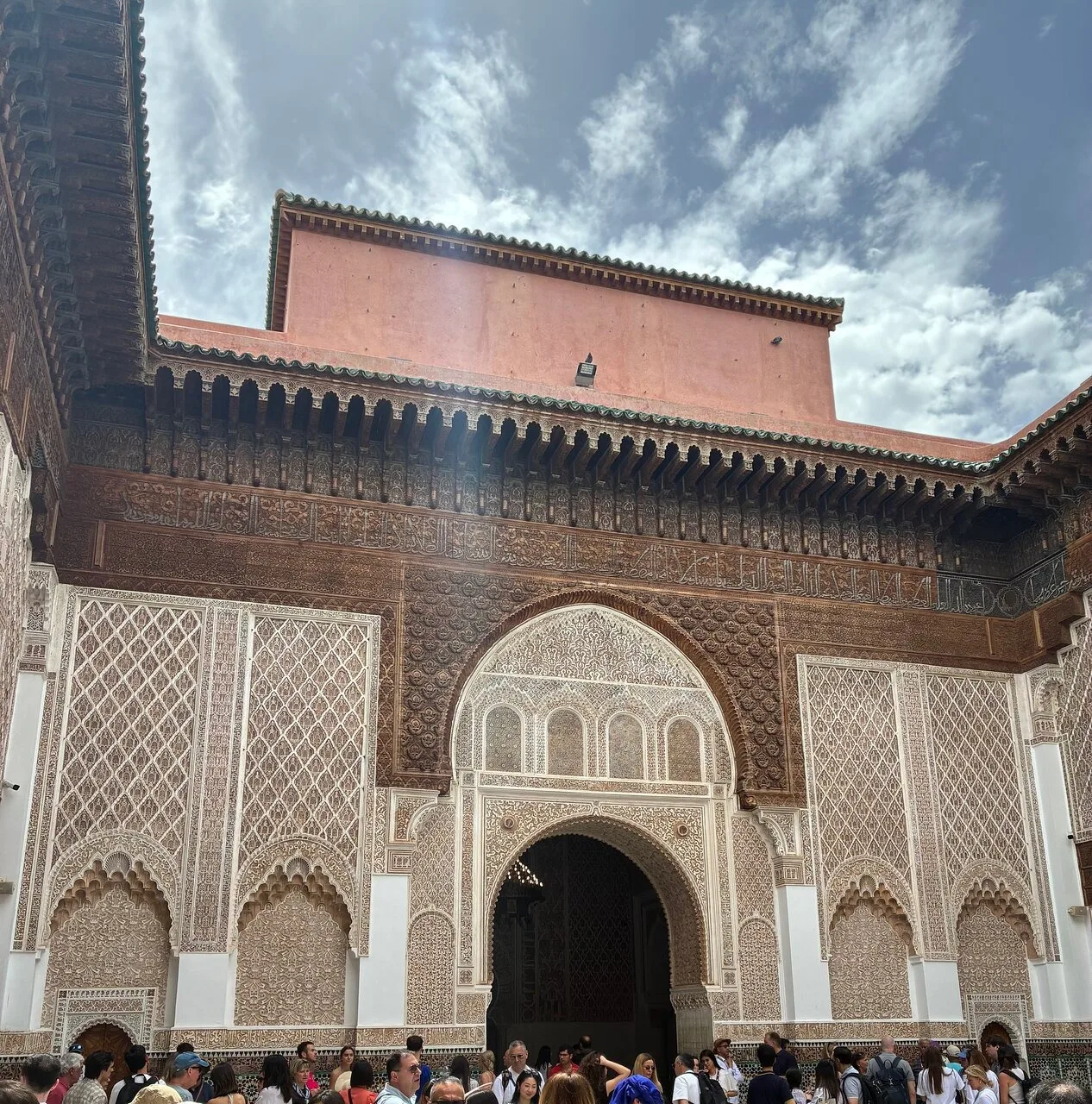
Inside the Ben Youssef Madrasa you walk through an entrance vestibule, into a marble courtyard with a long pool, then a prayer hall with a carved mihrab and an Andalusian basin, and up to the student rooms: 134 student rooms around 13 small courtyards: 54 on the ground floor and 80 upstairs (official architecture page). The whole visit takes about 45 minutes to 1 hour; up to 1.5 hours if you explore every upstairs room and take photos.
In short
- Courtyard: 21.90 × 16.50 m, paved in white marble, with a pool of about 3 × 7 m.
- Prayer hall: 16.40 × 8.17 m, with a five-sided mihrab whose arch is framed by four marble columns.
- Decoration: carved cedar, sculpted stucco, zellij tilework, marble and calligraphy.
- Don’t skip the upper floor: that is where most rooms are.
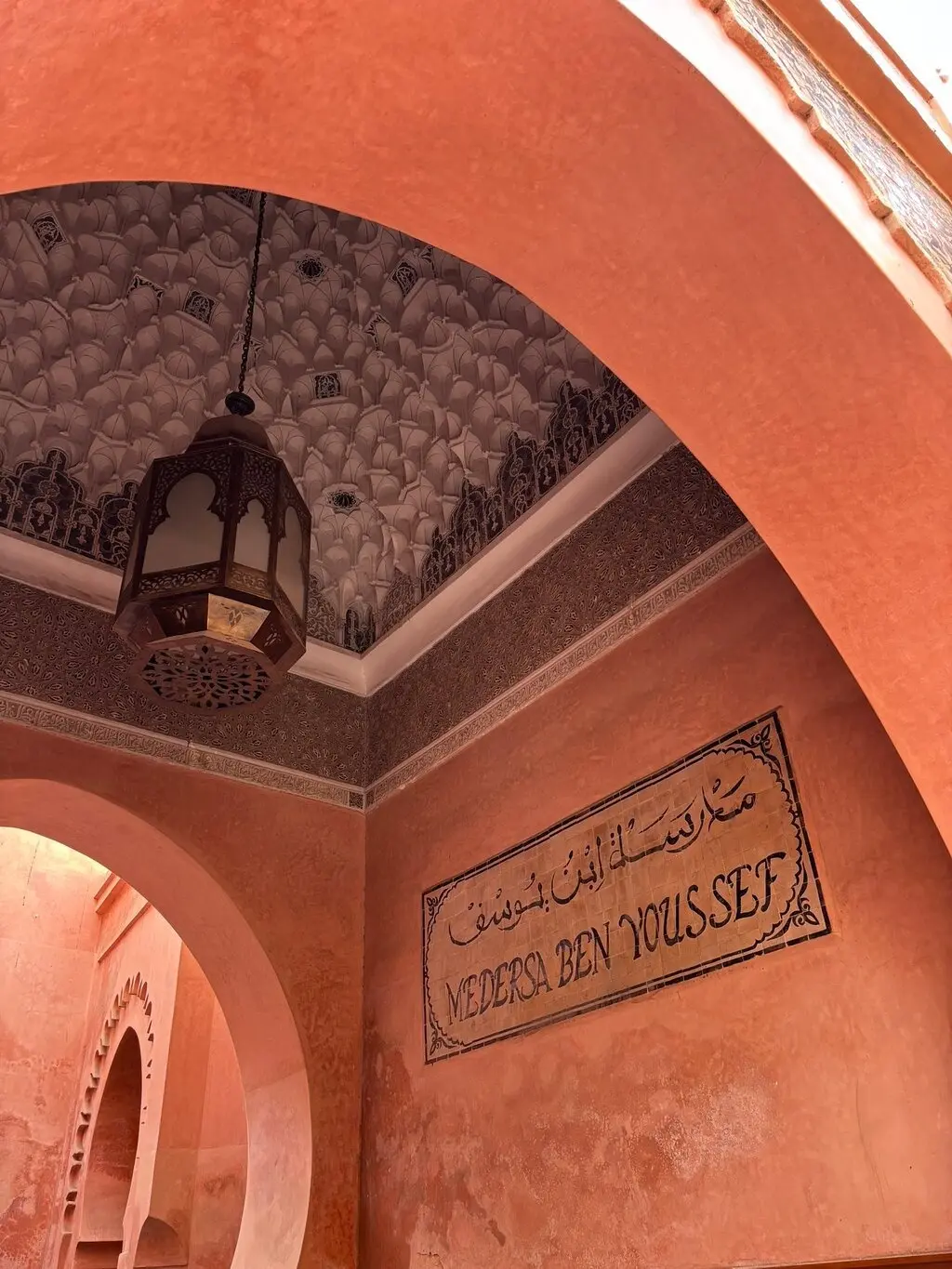
1. Street entrance and corridor
You enter from Rue Assouel and walk down a long, dim corridor. The ticket desk is just inside: 50 MAD for foreign adults.
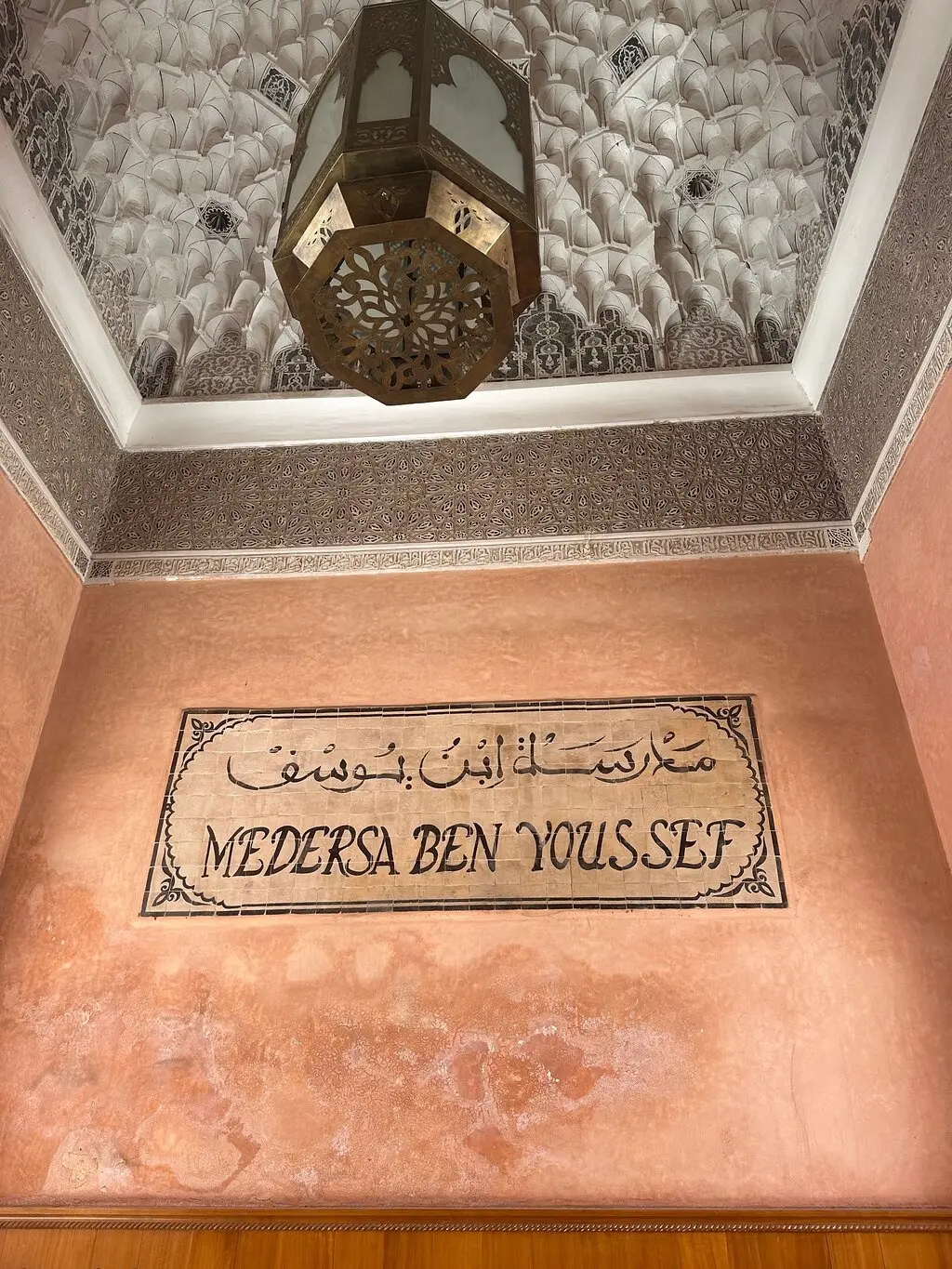
2. Vestibule and stairs
A carved door, geometric patterns, a carved wooden ceiling and zellij walls. The two stairways to the upper floor start here: remember them.
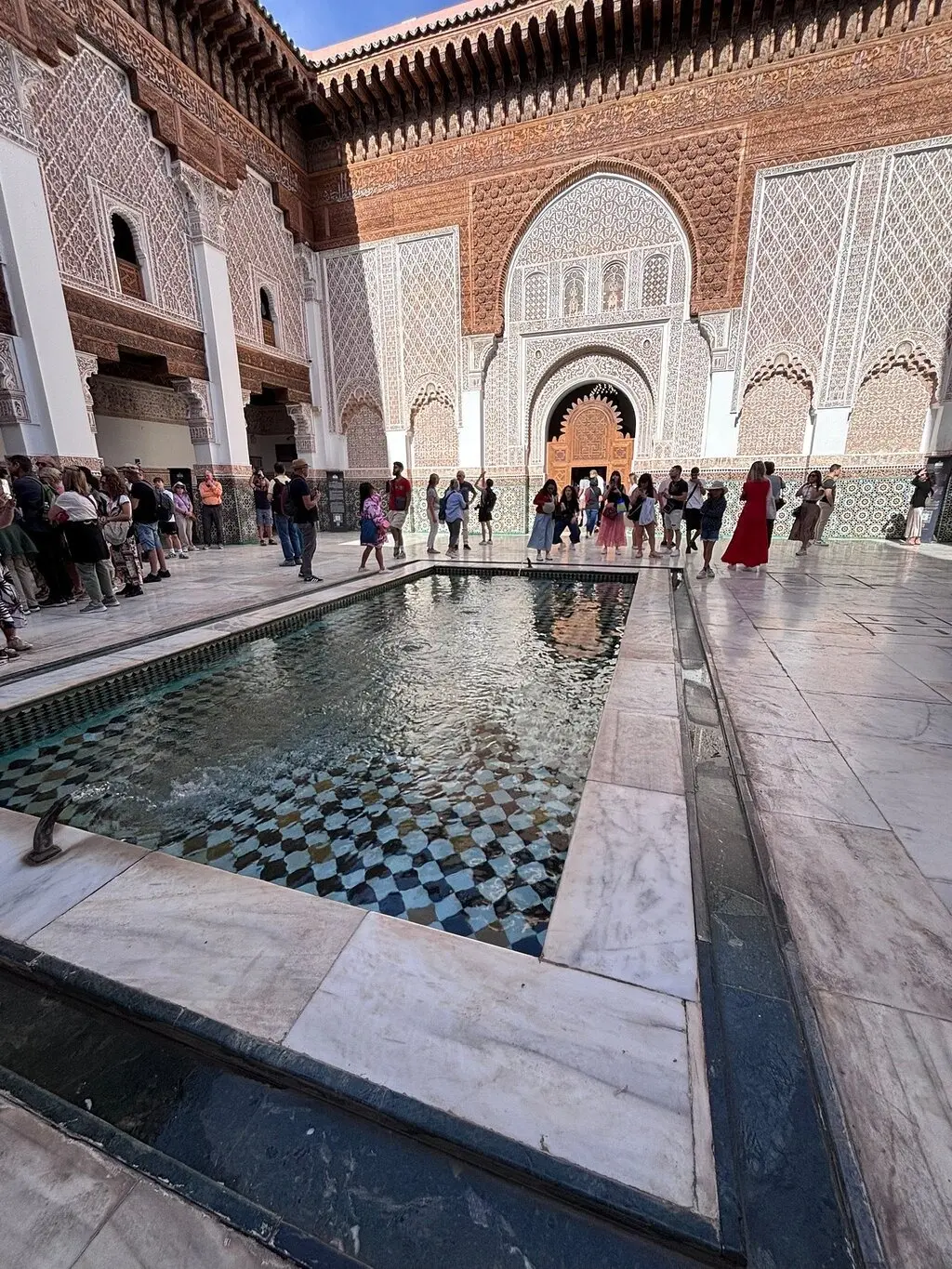
3. Main courtyard and pool
21.90 × 16.50 m, paved in white marble, with a pool of about 3 × 7 m. Stand at the end opposite the prayer hall for the reflection.
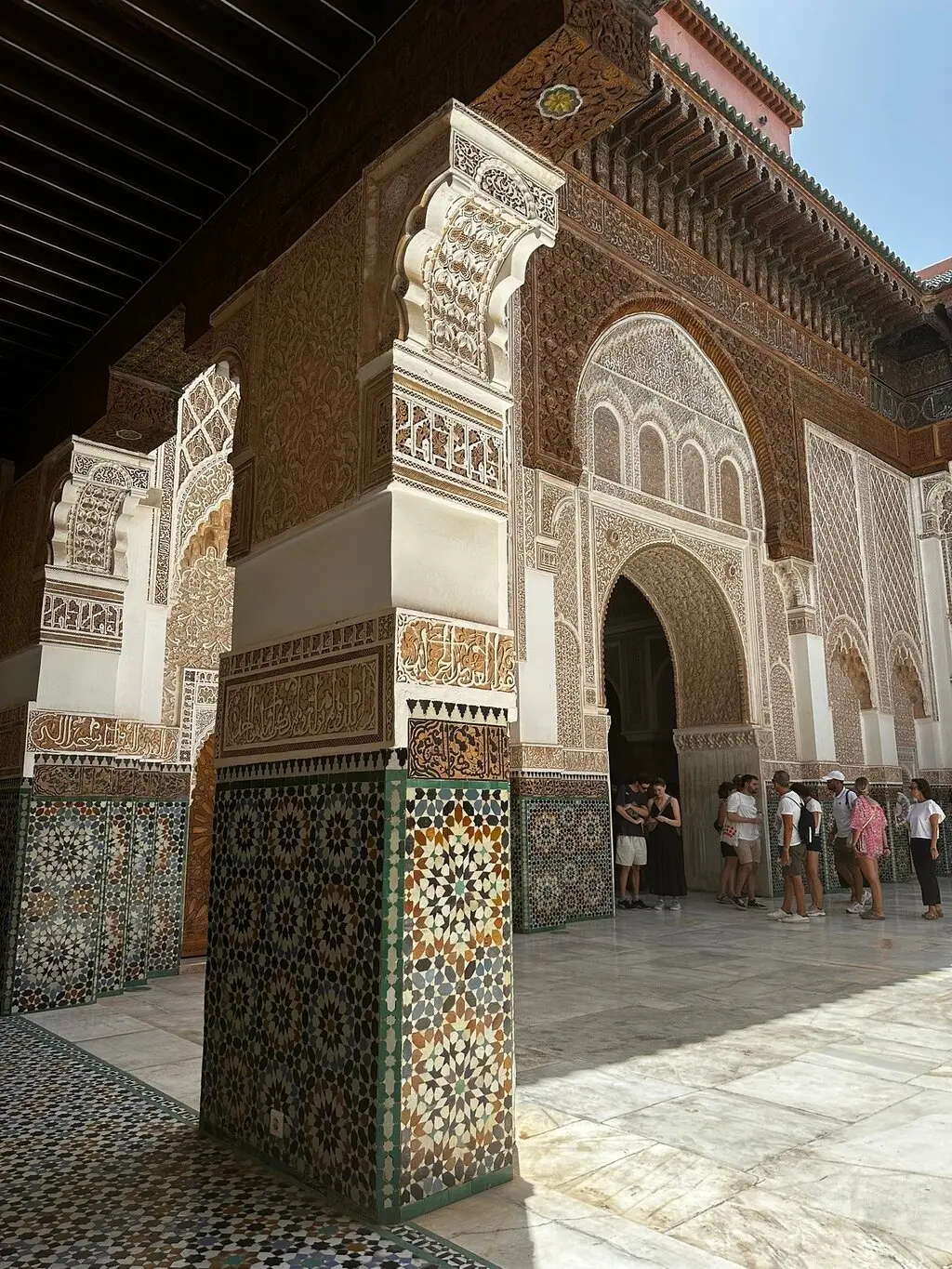
4. East and west porticos
Covered galleries run along the long sides of the courtyard: zellij pillars below, carved stucco above, cedar eaves under green tiles.
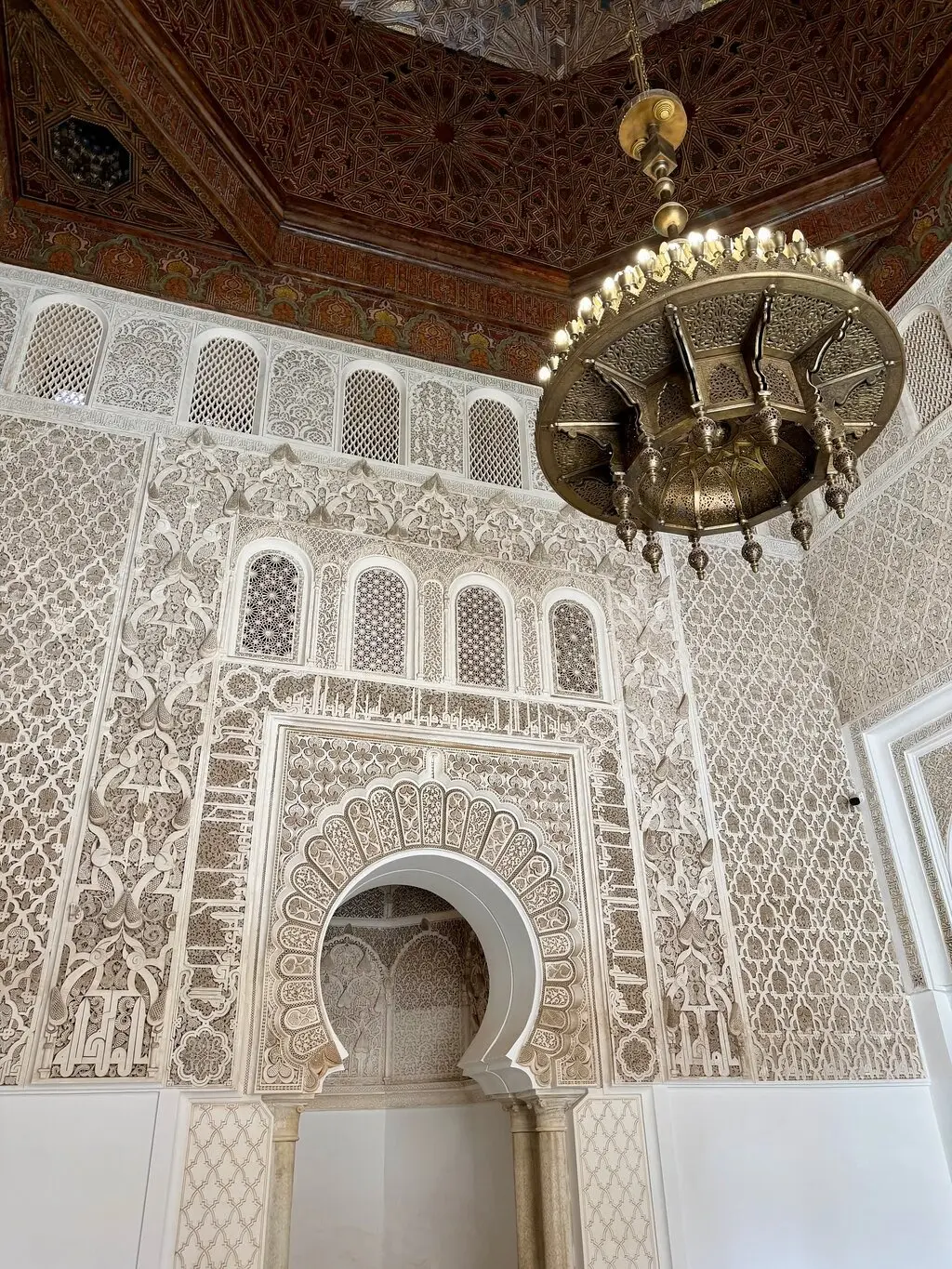
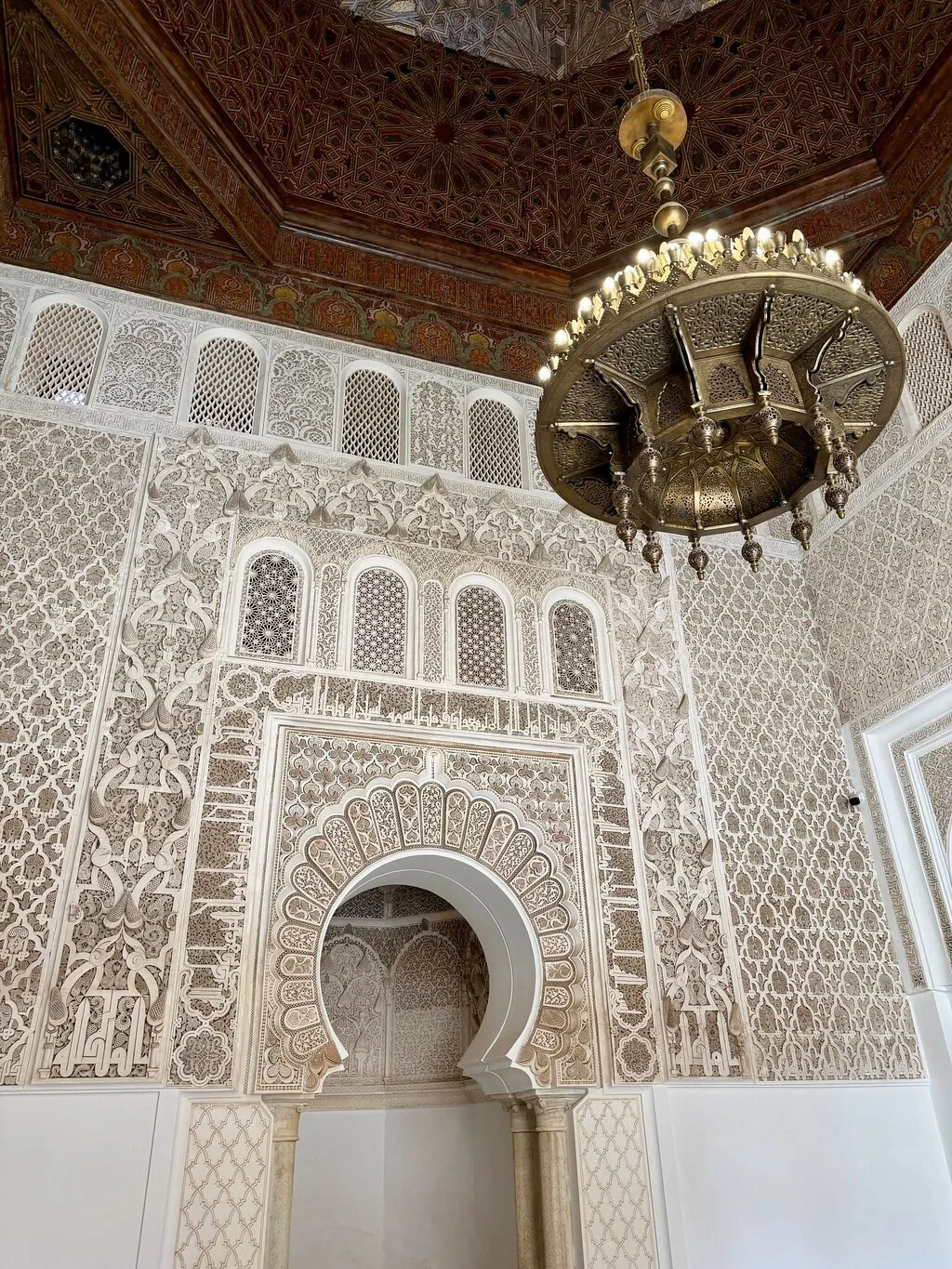
5. Prayer hall and mihrab
16.40 × 8.17 m, three naves, with a five-sided mihrab whose arch is framed by four marble columns. The richest stucco in the building, and a Kufic inscription around the mihrab arch.
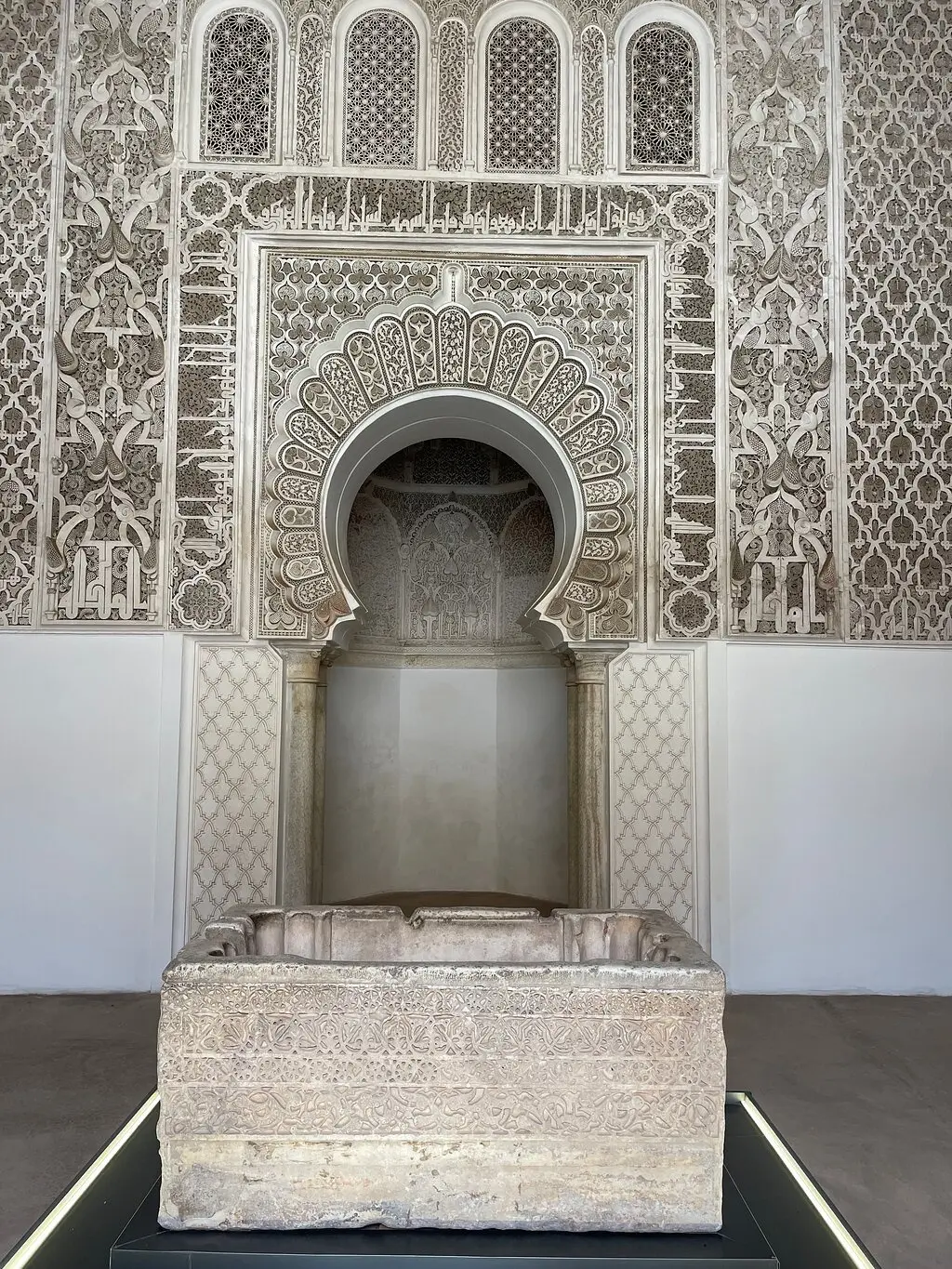
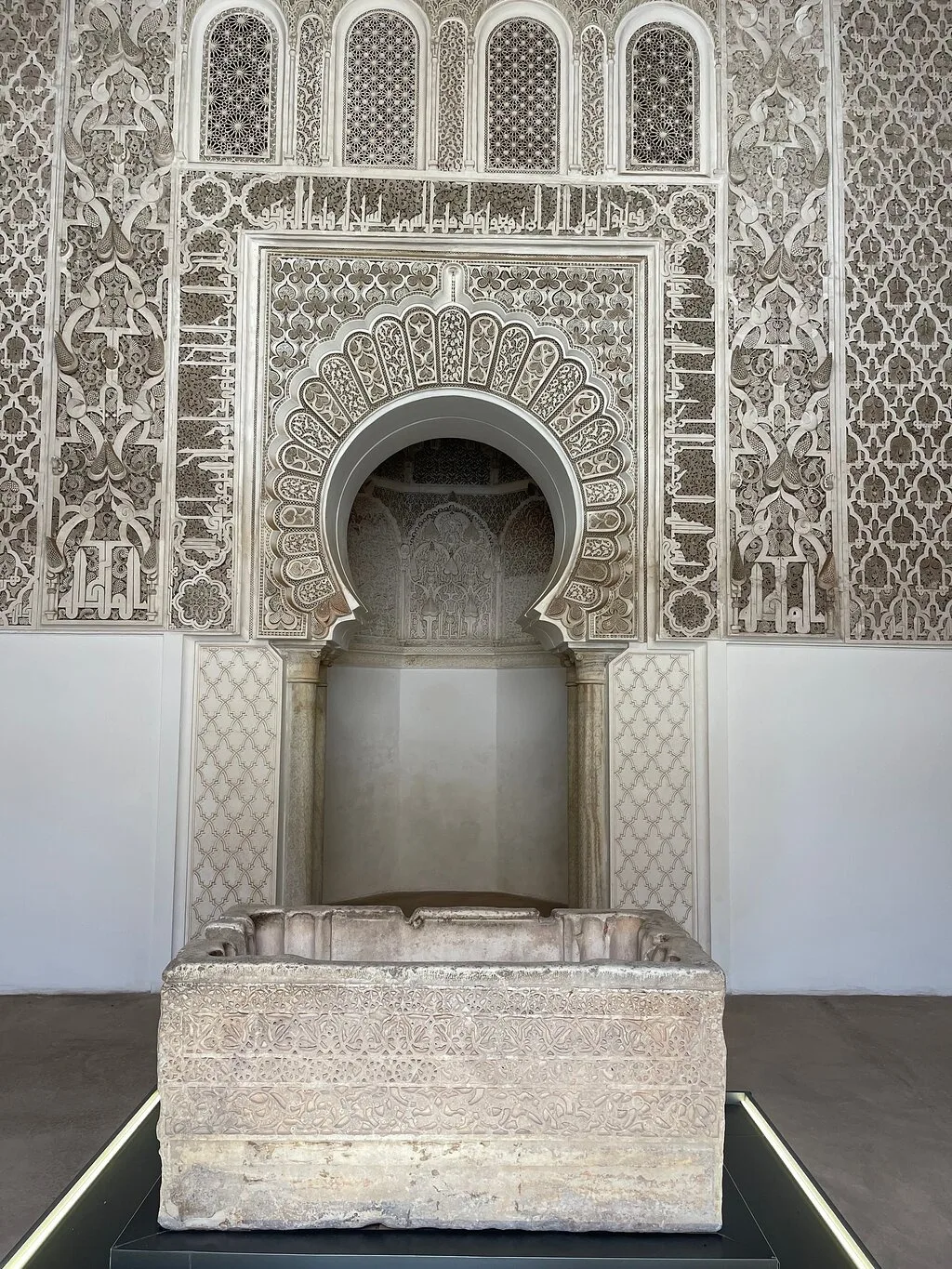
6. Andalusian basin
On display in the prayer hall: a marble basin carved in Córdoba’s Madinat al-Zahra between 1002 and 1007, with a Kufic inscription naming Abd al-Malik, son of the vizier al-Mansur, and carvings of birds and fish.
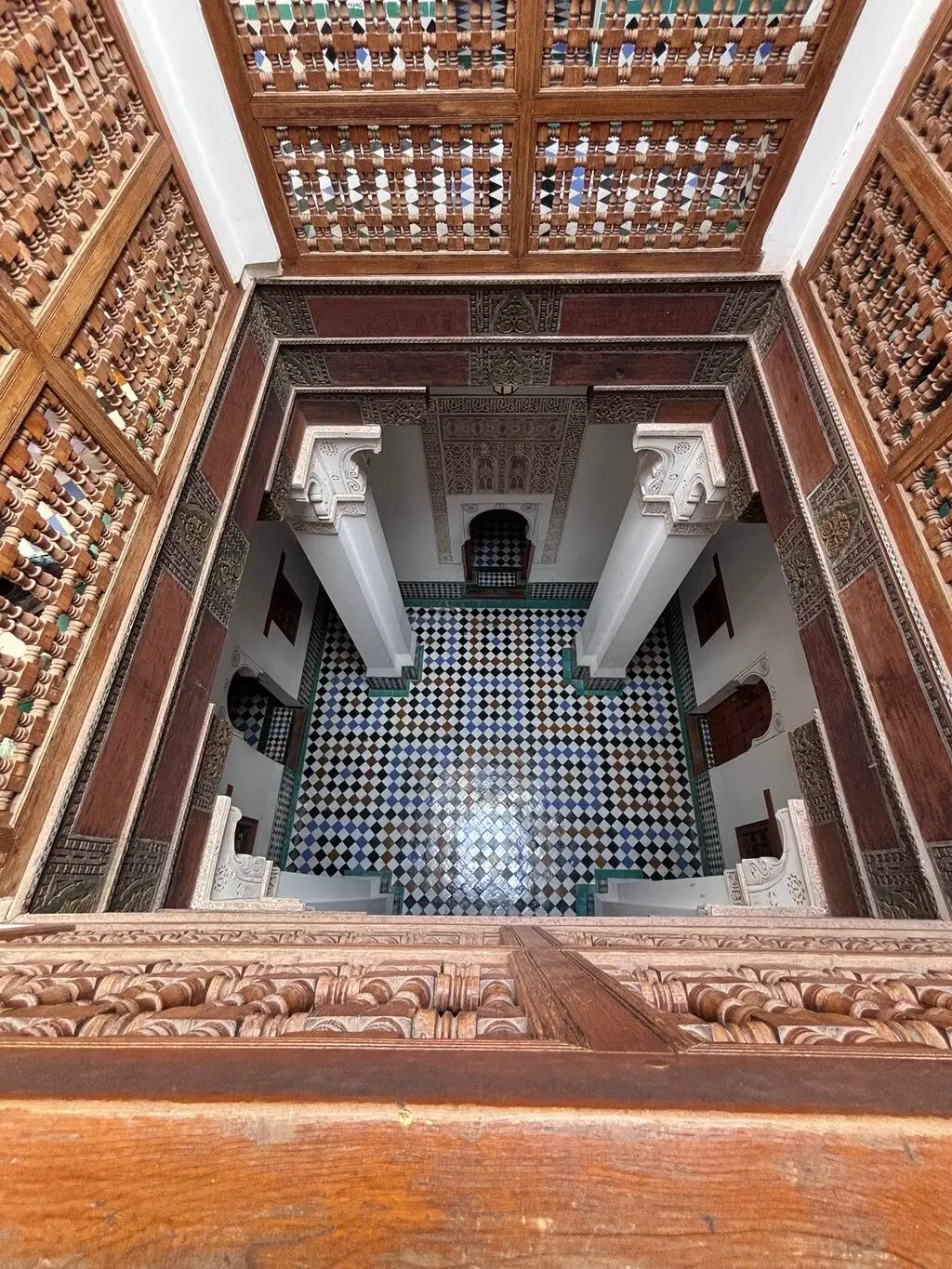
7. Student rooms and small courtyards
134 student rooms around 13 small courtyards: 54 on the ground floor and 80 upstairs. The rooms are tiny; some have a window onto the main courtyard.
8. Upper floor
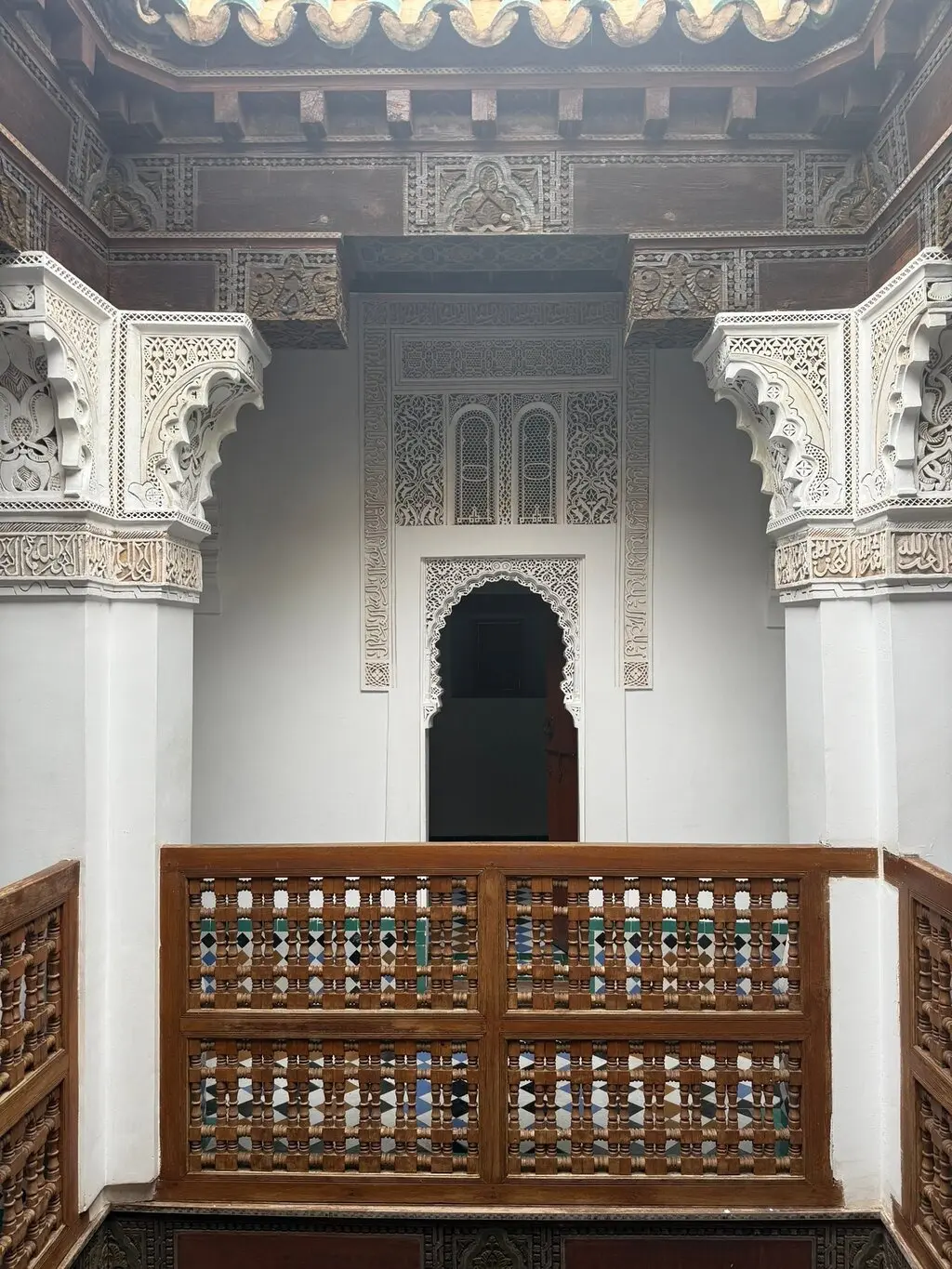
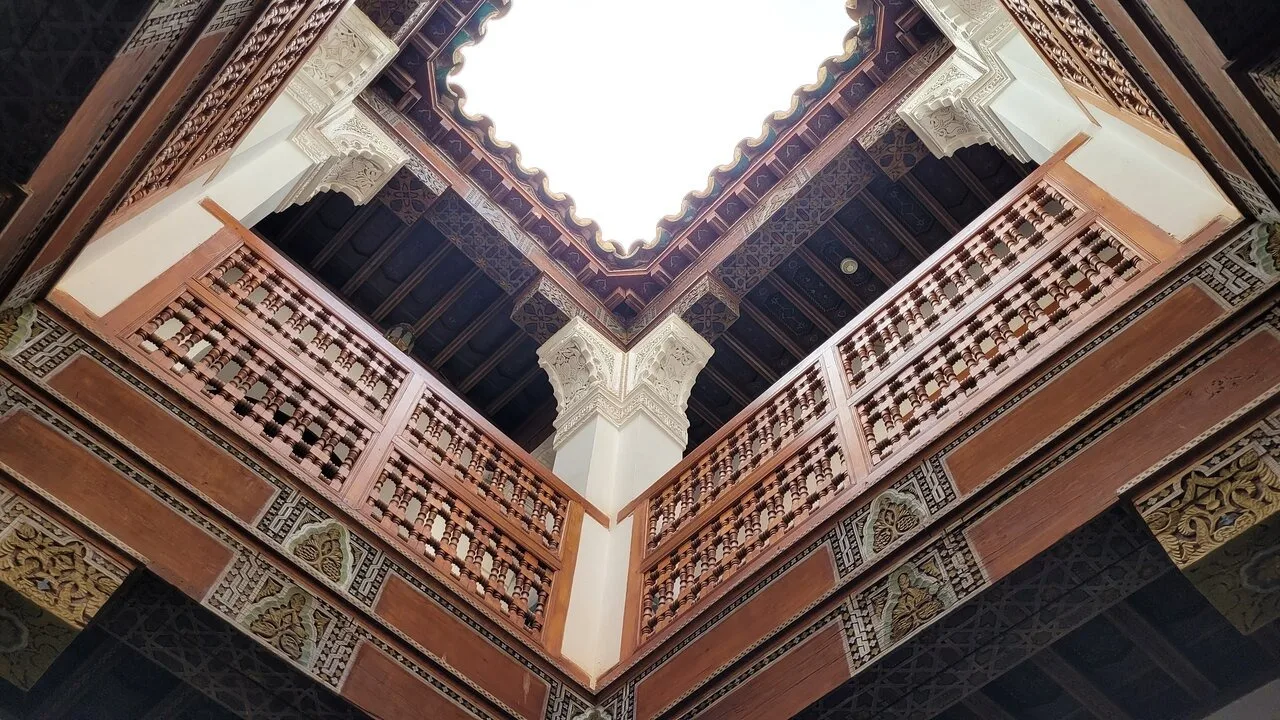
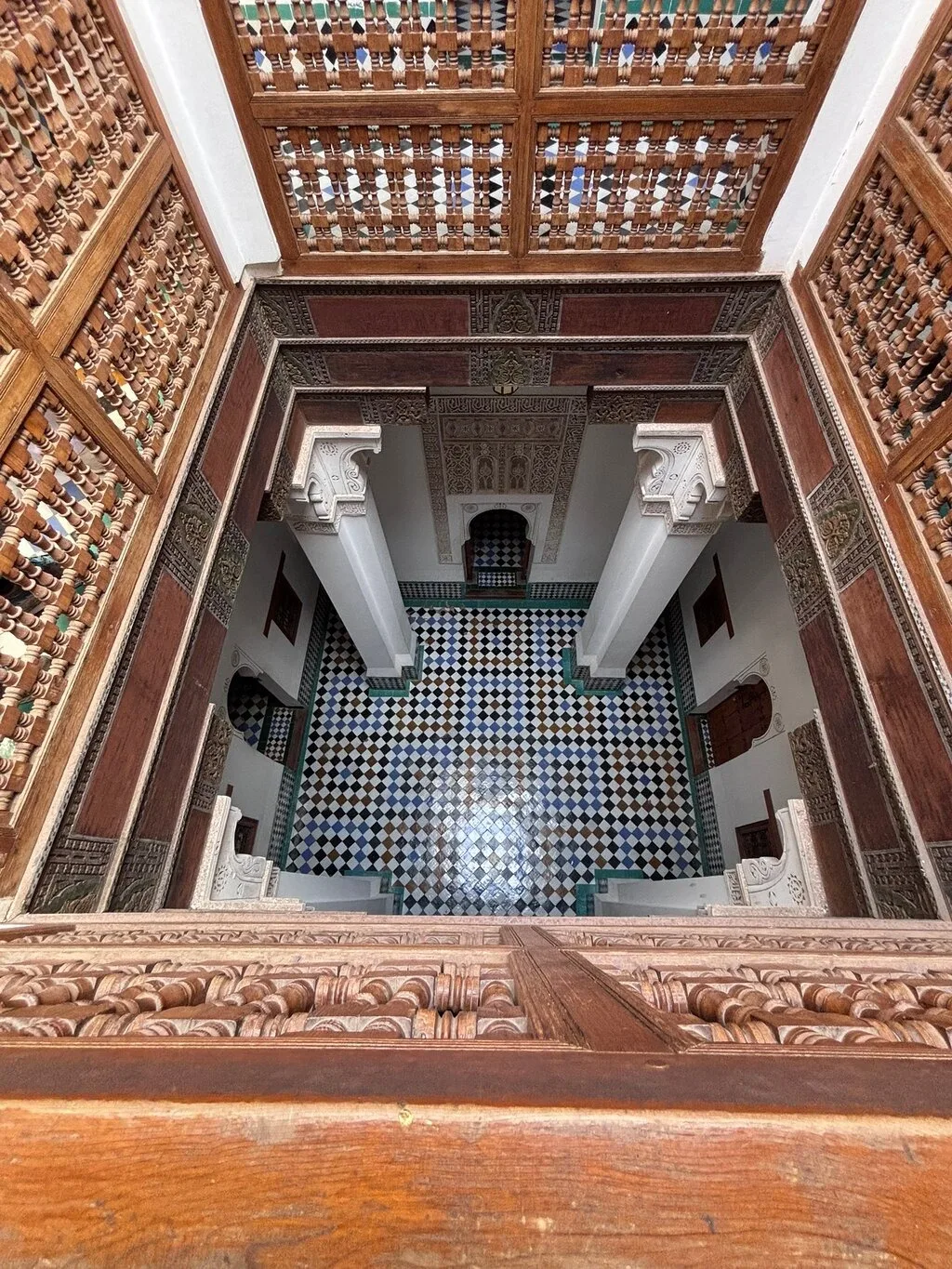
80 of the 134 rooms are upstairs, above the student blocks, around carved wooden balconies. Most visitors miss it.
9. Ablutions room
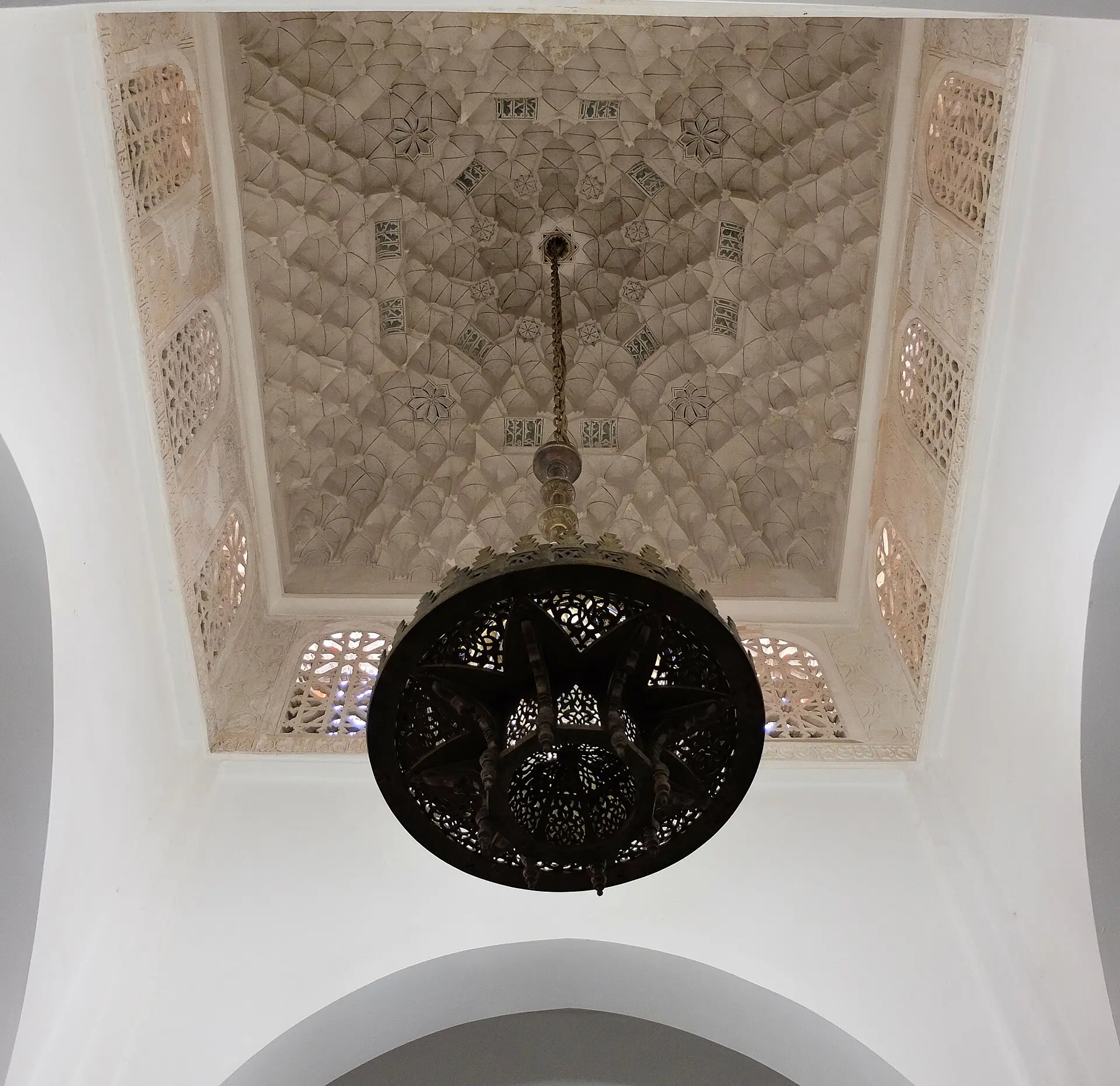
In the north-east corner of the ground floor, 6.25 × 5.25 m, under a dome carved with muqarnas.
Schematic plan, not to scale, drawn from the official architecture page. Upper floor: same footprint as the student blocks.
1. The entrance vestibule
You enter from the street through a long, dim corridor, a deliberate contrast with the bright courtyard to come. The official description notes the vestibule’s richly carved door, geometric patterns, carved wooden ceiling and zellij walls. Look up: the ceilings here are some of the finest woodwork in the building.
The two stairways to the upper floor also start in this area. Remember them for later.
2. The main courtyard and its pool
The courtyard is the image everyone knows: 21.90 × 16.50 m, about one-fifth of the building, paved in white marble with a long rectangular pool in the middle. Two porticos run along the east and west sides, and a cedar canopy covered with green tiles shades the walls.
The four facades are layered from bottom to top:
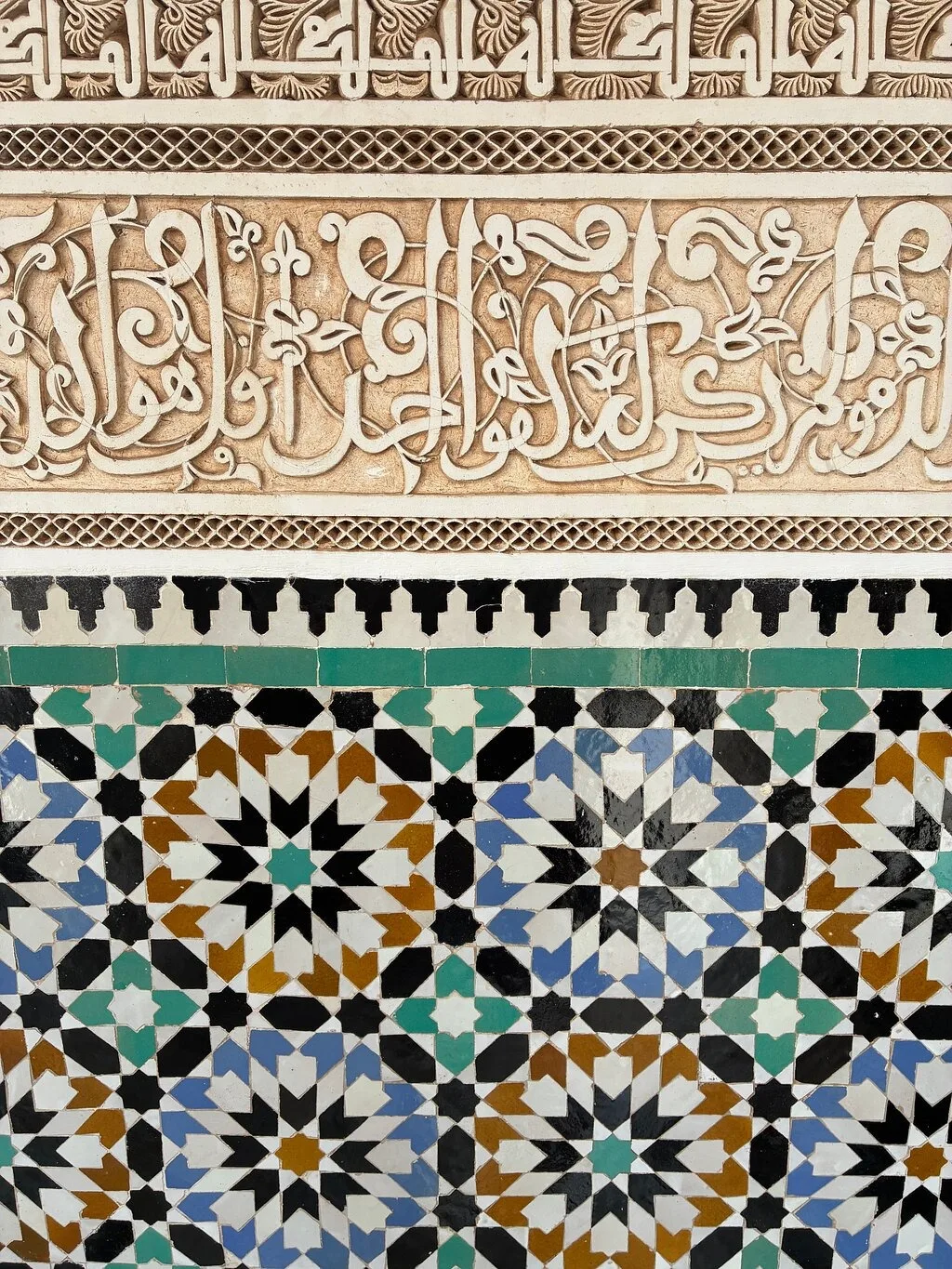
- Zellij tilework at the base, in geometric stars. The official site notes the tiles are 3 cm, double the usual thickness.
- Carved stucco above, with calligraphy bands and arabesques.
- Cedar wood at the top: carved lintels and eaves under the green-tiled roof.
Stand at the pool’s end opposite the prayer hall for the classic reflection shot. It works best early, before the water is disturbed and the courtyard fills.
3. The prayer hall and mihrab
At the far end of the courtyard, through a carved cedar door, is the prayer hall: 16.40 × 8.17 m, divided into three naves. Its focal point is the mihrab, the niche that shows the direction of Mecca: a five-sided mihrab whose arch is framed by four marble columns. The stucco here is the richest in the madrasa, and a large Kufic inscription runs around the mihrab arch.
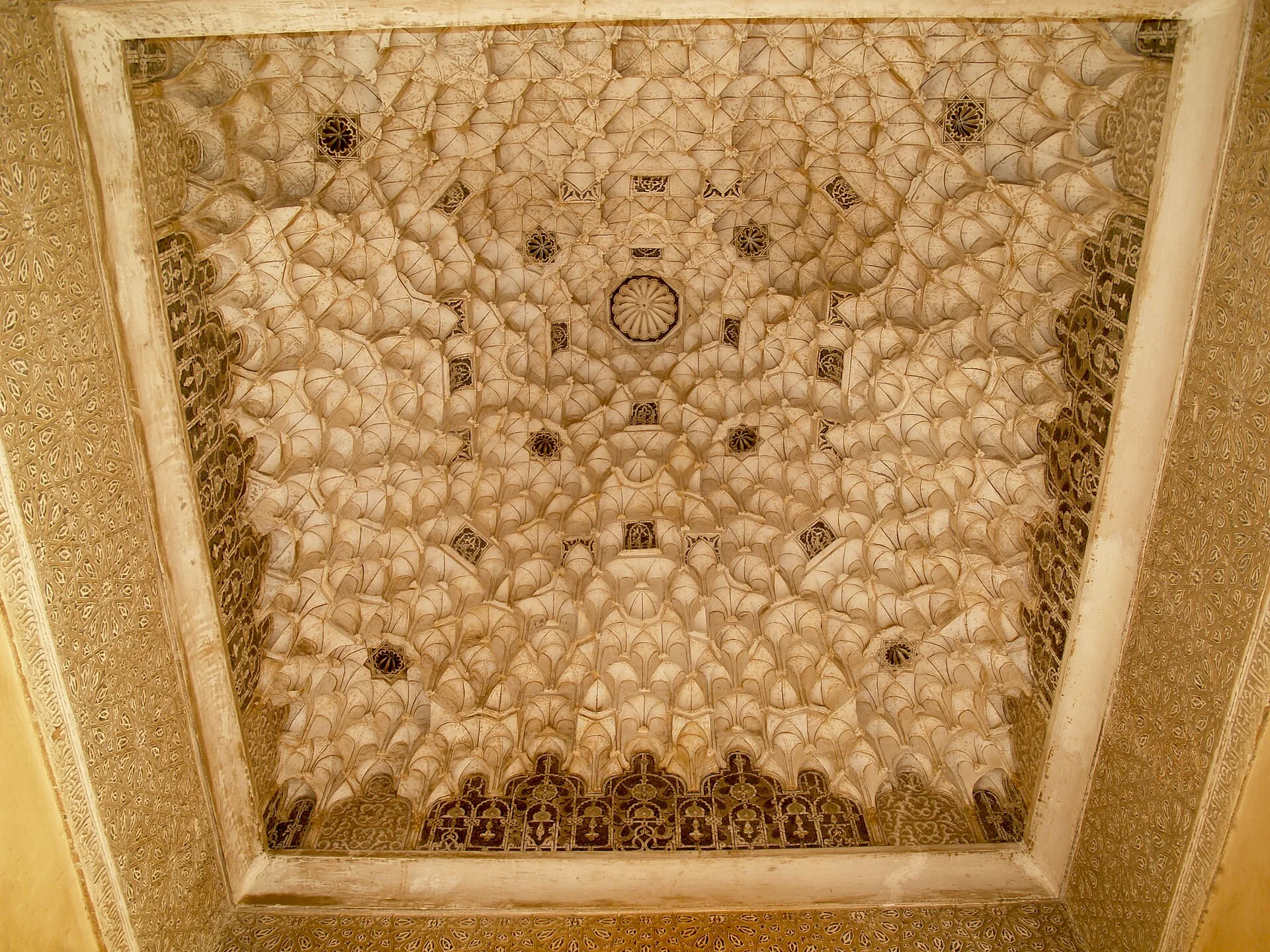
Above, look for the carved cedar ceiling and the muqarnas, the honeycomb-like carving inside the mihrab.
4. The Andalusian basin
The madrasa’s oldest object is older than the building by five centuries: a marble basin carved in Córdoba’s Madinat al-Zahra between 1002 and 1007, with a Kufic inscription naming Abd al-Malik, son of the vizier al-Mansur, and carvings of birds and fish. It is now displayed in the prayer hall. Look closely at the sides for the birds and fish (Wikipedia).
5. The student rooms and small courtyards
This is the part many visitors miss. The madrasa has 134 tiny rooms where students lived, grouped around 13 small courtyards: 54 on the ground floor and 80 upstairs. Climb the stairs from the vestibule and wander the narrow corridors. Each small courtyard has carved wooden balconies looking down into a well of light.
Step into a room or two: they are barely big enough for a bed mat and a few books, and some have a window onto the main courtyard. That view down onto the pool is one of the best in the building.
6. The details most people walk past
- The ablutions room in the north-east corner, with a domed muqarnas ceiling.
- The water system: rain from the roofs once filled the courtyard basin, and a conical maada in the vestibule distributed water.
- The bird in the balustrade: a small bird carved into one of the wooden balustrades. Finding it is a small game.
- The foundation inscription near the entrance, which records the Saadian completion in 972 AH (1564–1565).
The building’s story, from the Marinids to the 2022 reopening, is in our history guide. Practical next steps: tickets · opening hours · how to get there.
Questions people ask
What is inside the Ben Youssef Madrasa?
An entrance vestibule, a marble courtyard (21.90 × 16.50 m) with a pool, a prayer hall with a mihrab, an Andalusian marble basin and 134 student rooms around 13 small courtyards: 54 on the ground floor and 80 upstairs.
How many rooms does the Ben Youssef Madrasa have?
134 student rooms: 134 student rooms around 13 small courtyards: 54 on the ground floor and 80 upstairs.
Can you go upstairs at the Ben Youssef Madrasa?
Yes. Two stairways lead from the entrance vestibule to the upper floor, where most of the student rooms are.